
A Drawer of Unused Stationery: A Fossil Bed of the Ideal Self
A drawer brimming with unopened notebooks, pens, and other stationery might initially seem like nothing more than clutter. Yet, it often acts more like a fossil bed, preserving layers of a person’s shifting ambitions and self-perceptions over time. Each item tucked away tells a story about moments when someone genuinely believed that a leather-bound notebook or a finely crafted pen was the missing piece to unlock a better version of themselves. Digging through these layers reveals receipts, hopes, and a slow archaeology of intention.
Contrary to common assumptions that such drawers remain full because their owners are disorganized or wasteful, psychological research on regret and the ideal self offers a richer explanation. For many, discarding these objects can feel like acknowledging a failure to become the person they once aspired to be, making the act emotionally complex.
The Gap Between the Person Buying the Pen and the Person Meant to Use It
Psychologists describe three coexisting versions of the self within an individual: the actual self (who we currently are), the ought self (the person we feel obligated to be), and the ideal self (the aspirational version shaped by hopes and dreams). According to research summarized by Thomas Gilovich and Shai Davidai, failures to realize the ideal self are a particularly potent source of regret. (source)
In this light, an unopened notebook symbolizes the ideal self—a future where mornings might begin with calm reflection and clear, purposeful writing. The pen matches that vision, chosen to complement a hopeful routine. Yet, it is the actual self that ultimately inherits the drawer, often one less aligned with those aspirations.
Photo by Magda Ehlers on Pexels
Why the “Coulda” Regret Sticks Longer Than the “Shoulda”
Gilovich and Davidai’s research highlights that regrets tied to unfulfilled hopes and goals (“coulda” regrets) tend to linger longer than those associated with neglected duties (“shoulda” regrets). Regrets linked to obligations can sometimes be remedied by concrete actions such as making amends or completing tasks, which provide closure.
In contrast, “coulda” regrets persist because the imagined future often remains technically attainable. The unwritten novel might still be written, the unused journal may yet be filled, and the opportunity seems perpetually open. This ongoing possibility keeps the regret active.
The stationery drawer epitomizes this tension. Each new notebook can be read as a sign that the window to self-improvement remains ajar. Yet, it simultaneously serves as evidence that another year has passed without stepping through it.
What the Zeigarnik Effect Can and Cannot Explain
Bluma Zeigarnik’s 1927 experiments suggested that people remember interrupted tasks better than completed ones, a phenomenon known as the Zeigarnik effect. However, a 2025 meta-analysis by Romain Ghibellini and Beat Meier challenges the universality of this effect, finding no general memory advantage for unfinished tasks. Instead, the effect depends on context and individual differences. (source)
While the idea that unfinished business demands more mental space remains a useful metaphor, it should not be treated as a universal truth. For some, the stationery drawer may hum with emotional tension; for others, it remains silent.
In relationships, unresolved feelings can lead people to mentally revisit incomplete endings. A Forbes article argues that this “love’s Zeigarnik effect” keeps people returning to unresolved emotional loops. (source) An unopened notebook can parallel this experience on a smaller scale—an analogy rather than definitive proof that every unused notebook harbors an active psychological loop.
Opportunity, and the Strange Weight of a Still-Open Door
Opportunity intensifies regret because it implies the possibility of corrective action. Neal Roese and Amy Summerville’s 2005 study found that greater perceived opportunity correlates with more intense regret. Their review highlighted education as a prominent source of American regret, partly because returning to education is often feasible throughout adulthood. (source)
The stationery drawer follows this logic. The tools remain—pens still write, pages remain blank—and the person might still become the writer they once envisioned. Discarding these objects can feel like closing a door on that possibility, a declaration many are not ready to make. Thus, the drawer stays because the opportunity does too.
The Particular Grief of the Notebook You Almost Used
Notebooks opened briefly and then abandoned carry a unique emotional weight. Unlike sealed notebooks that contain pure potential, partially filled notebooks bear witness to interrupted attempts. The careful handwriting on page one, loosening by page three, and eventual abandonment reflect a fleeting appearance of the hoped-for self.
The remaining blank pages often bear signs of wear—warped from transport or storage—becoming relics of unrealized ambition. Discarding such a notebook can feel like discarding a version of oneself mid-failure, a far more complicated act than throwing away blank paper. It’s no surprise that such decisions rarely feel pressing on an ordinary day.
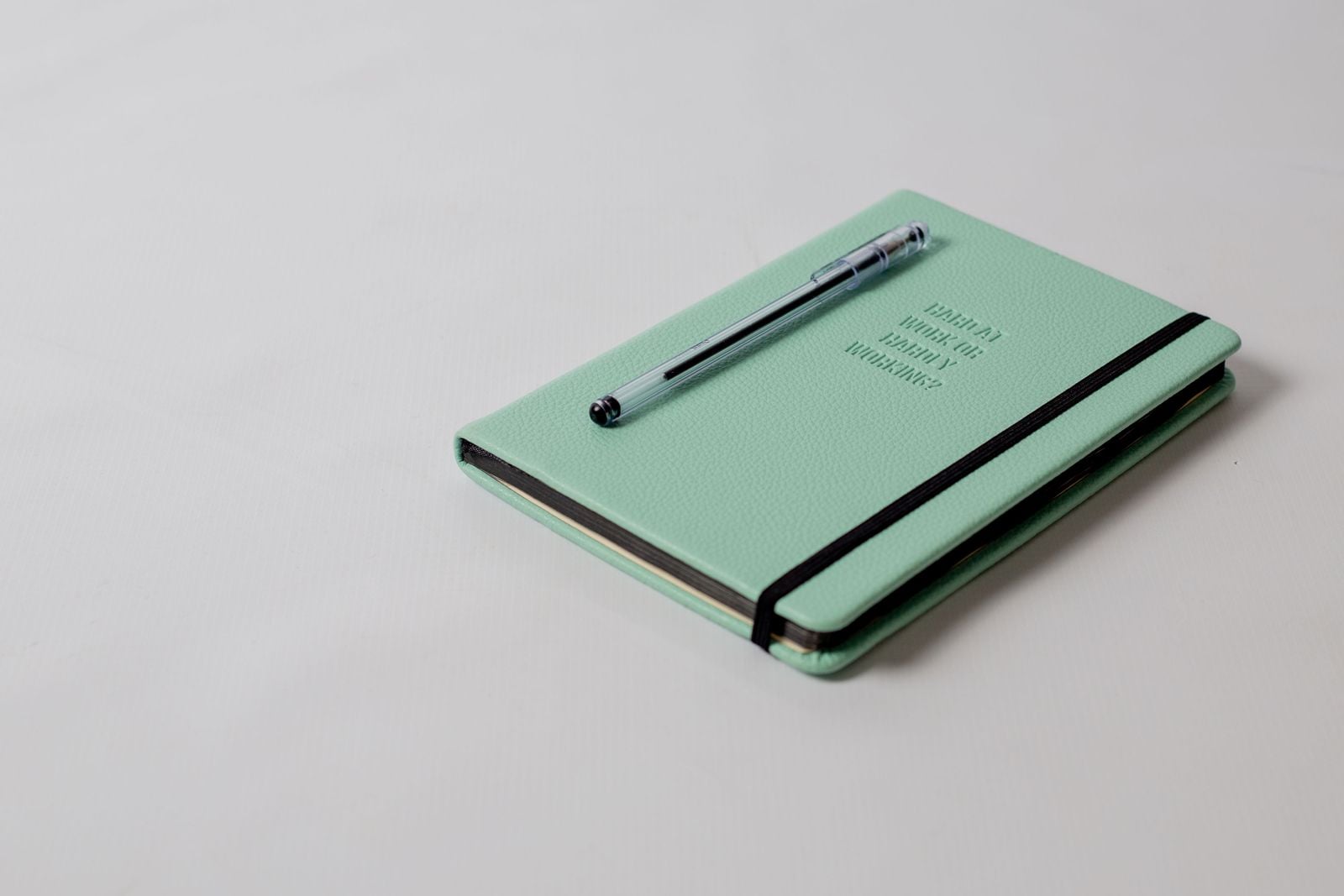
Photo by Nathi Ngwenya on Pexels
Why the Ideal Self Keeps Buying More Supplies
The goals tied to the ideal self are often abstract—becoming a good writer, fostering creativity, or making time for meaningful work. These goals lack clear completion markers, making progress difficult to measure.
In contrast, the ought self handles concrete tasks like filing paperwork or attending appointments, each with visible endpoints.
Because the ideal self cannot easily quantify progress, it gravitates toward symbolic markers of advancement. A new notebook, a high-quality pen, or a planner with the perfect layout can temporarily bridge the gap between aspiration and reality. For a brief moment after purchase, the ideal self and the actual self seem aligned.
But as everyday life resumes, the overlap fades, and the drawer claims the notebook. These purchases are not frivolous—they keep the writer-self alive as an identity, even if the work itself never materializes.
The Brain Dump That Never Happens
Productivity experts often recommend a brain dump: writing down every task, idea, or responsibility to clear mental clutter and prioritize effectively. (source)
The stationery drawer can be seen as a physical brain dump that never fully materialized. Each notebook represents a project or idea the ideal self intended to externalize. Ironically, the tools designed to help offload mental clutter become the clutter themselves when unused.
What the Objects Are Actually Doing
It helps to recognize what a drawer of unused stationery truly holds. It might preserve memories of a Sunday afternoon spent believing a fountain pen could rekindle a writing habit. It might contain a birthday gift meant to encourage poetry or a notebook bought impulsively at an airport before a transformative trip that mostly failed to change anything.
These items are more than mere office supplies—they are timestamps capturing moments of hope, tenderness, ambition, or escape. Their practical use may have expired, but their symbolic significance endures.
Similar patterns emerge in other domains, such as coats that outlast friendships or voicemails kept long after a loved one has passed. Objects often take on new roles beyond their original purpose, carrying meaning much like a bookmark signals a place in a story.
The Tool Is Not the Block
The uncomfortable truth is that the stationery was likely never the missing piece. Writing may not have happened due to time constraints, exhaustion, competing responsibilities, or fears—whether of poor quality or mediocrity. A better pen does not resolve these underlying challenges.
Yet, believing in the pen’s power served a purpose: it kept the writer-self alive as a viable identity, even when no pages were produced. As long as the supplies remained, that aspirational self did not feel entirely lost.
Earlier research summarized by Gilovich and Davidai found that people do not regret time spent learning skills or pursuing hobbies they later abandoned. Deeper regret centers on skills never attempted at all. (source) Thus, a badly written and abandoned page may weigh less heavily on a life than an unused notebook gathering dust.
What the Loop Actually Needs
Unresolved endings do not always require external answers to reach closure. According to the Forbes feature on love’s Zeigarnik effect, people can create their own conclusions by acknowledging what remains unfinished and accepting that some questions may never be answered. (source)
Applied to a stationery drawer, this process resembles acknowledgment more than aggressive decluttering. The notebook belonged to a real version of the person who wanted to write. That identity remains valid even if the project never fully materialized. The object can be used, gifted, or discarded without mocking or erasing that self.
Some may finally open the notebook and write; others may find honesty in giving it away. Neither choice signifies failure.
The Quiet Reason the Drawer Is Kept
Yes, the drawer may be cluttered, and excessive purchasing may sometimes play a role. Yet for many adults, it is also a small museum of selves once believed in. Each pen and notebook was bought in a moment filled with hope that the gap between the person writing a shopping list and the person who might write something more could at last close.
That this gap remains open is not a moral failing. It reflects the reality of competing demands, tired evenings, and obligations with clearer deadlines. The notebook may have lost that competition, but the hope it embodied does not vanish so easily.
Before deciding whether to keep or thin out the drawer, it is worth recognizing what each object once represented. Much of the contents were purchased by someone who believed change was still possible—a belief that may deserve acknowledgment, even when the paper itself is finally allowed to go.

