
The Silent Drift: How Sperm Whales Sleep Standing Up
For nearly fifteen minutes, a suction-cupped tag attached to the back of a wild sperm whale recorded nothing but stillness: no changes in depth, no rolling or pitching, and no echolocation clicks. Then, as the whale exhaled, the sensors sprang to life and the pod around it resumed movement. This remarkable observation marks the first instrumented confirmation of a sleep behavior long described—but never scientifically verified—by whalers and sailors: sperm whales sleep vertically, standing upright in the ocean.
Groups of five or six adult whales hang motionless, noses pointing toward the surface, tails dangling into the dark depths below. They remain completely silent and still for about fifteen minutes at a time before waking to breathe and carry on. This unique sleeping posture and the brevity of their rest periods set sperm whales apart from all other mammals.
A Posture No One Expected
Sperm whales are giants of the deep, with adult males reaching lengths of over 15 meters and weighing several dozen tonnes. Their massive heads, which constitute roughly one-third of their body length, contain the spermaceti organ—a waxy structure that aids in buoyancy control and echolocation. When a sperm whale ceases swimming and relaxes its muscles, the density difference between the heavy tail and the buoyant, oil-filled head causes it to tip head-up, floating vertically in the water column with eyes closed.
These whales do not rest alone. Researchers have documented pods of five to six whales drifting in tight formation, each separated by just a few body lengths, all aligned in the same direction. From above, this arrangement resembles a cluster of pale tree trunks suspended beneath the waves, an unusual sight in the animal kingdom.
Yet, despite their enormous size, sperm whales spend less than two hours sleeping per day—among the shortest sleep durations recorded for any mammal. For comparison, bats may sleep up to twenty hours daily, humans typically eight, and giraffes only a few hours. The sperm whale’s minimal sleep demands raise fascinating questions about the evolutionary pressures shaping its unique rest patterns.
Fifteen Minutes, Then Back to the Hunt
Each sleep episode lasts approximately twelve to fifteen minutes, after which whales surface to breathe before either drifting again or diving deep to hunt squid. Unlike many marine mammals—including dolphins, belugas, and seals—that engage in unihemispheric sleep (resting one half of the brain while the other remains alert), sperm whales appear to sleep with both brain hemispheres simultaneously. During these brief naps, they become almost completely unresponsive, sometimes allowing boats to approach closely without waking.
This full-brain offline state is highly unusual and suggests a sleep architecture distinct from other cetaceans. The ability to briefly “power down” completely, despite the risks involved in the open ocean, reflects a carefully balanced evolutionary strategy.
Why So Little Sleep, and Why Standing Up?
Sperm whales’ demanding lifestyle leaves little time for rest. As obligate breathers, every breath is deliberate, and their foraging dives can last up to an hour at depths exceeding 1,000 meters. Their daily routine centers on long, deep dives separated by brief surface intervals, constraining the window available for sleep.
The vertical sleeping posture results from the whale’s anatomy and physics. The spermaceti organ shifts the center of buoyancy forward of the center of mass, causing the animal to tip head-up and float vertically when relaxed. Studies tracing cetacean evolution reveal how terrestrial ancestors adapted over tens of millions of years—reshaping skulls, sinuses, and respiratory control—to thrive in aquatic environments.
Interestingly, this buoyancy adaptation distinguishes cetaceans from ancient marine crocodilians, such as thalattosuchians, whose large snout sinuses would have collapsed under pressure, restricting deep diving. Whales replaced these bone-enclosed sinuses with external air sacs that equalize pressure, enabling deep dives followed by relaxed, vertical drift-sleeping near the surface.
The Pod as a Single Sleeping Unit
The sleeping formation of sperm whales is far from random. Whales align closely to form a cohesive unit, with calves typically nestled in the center, protected by adults facing the same direction. This coordinated drifting likely reflects the species’ deep social bonds and cooperative behaviors.
Recent studies from Project CETI, which documented a rare sperm whale birth and cooperative care, highlight the importance of group cohesion. Adults from across the social unit converge to protect and nurture newborns, behaviors that are culturally transmitted and ancient. This cooperative spirit extends to sleep: while lone sperm whales rarely drift, pods do, resting together as a single social entity.
How Sleep Behavior Was Captured
Prior to modern tagging technology, the vertical drifting posture was known mostly from anecdotal reports by whalers and sailors. The breakthrough came with the advent of miniaturized digital acoustic recording tags (D-tags), which can be suction-cupped onto whales to monitor depth, pitch, roll, heading, and sound.
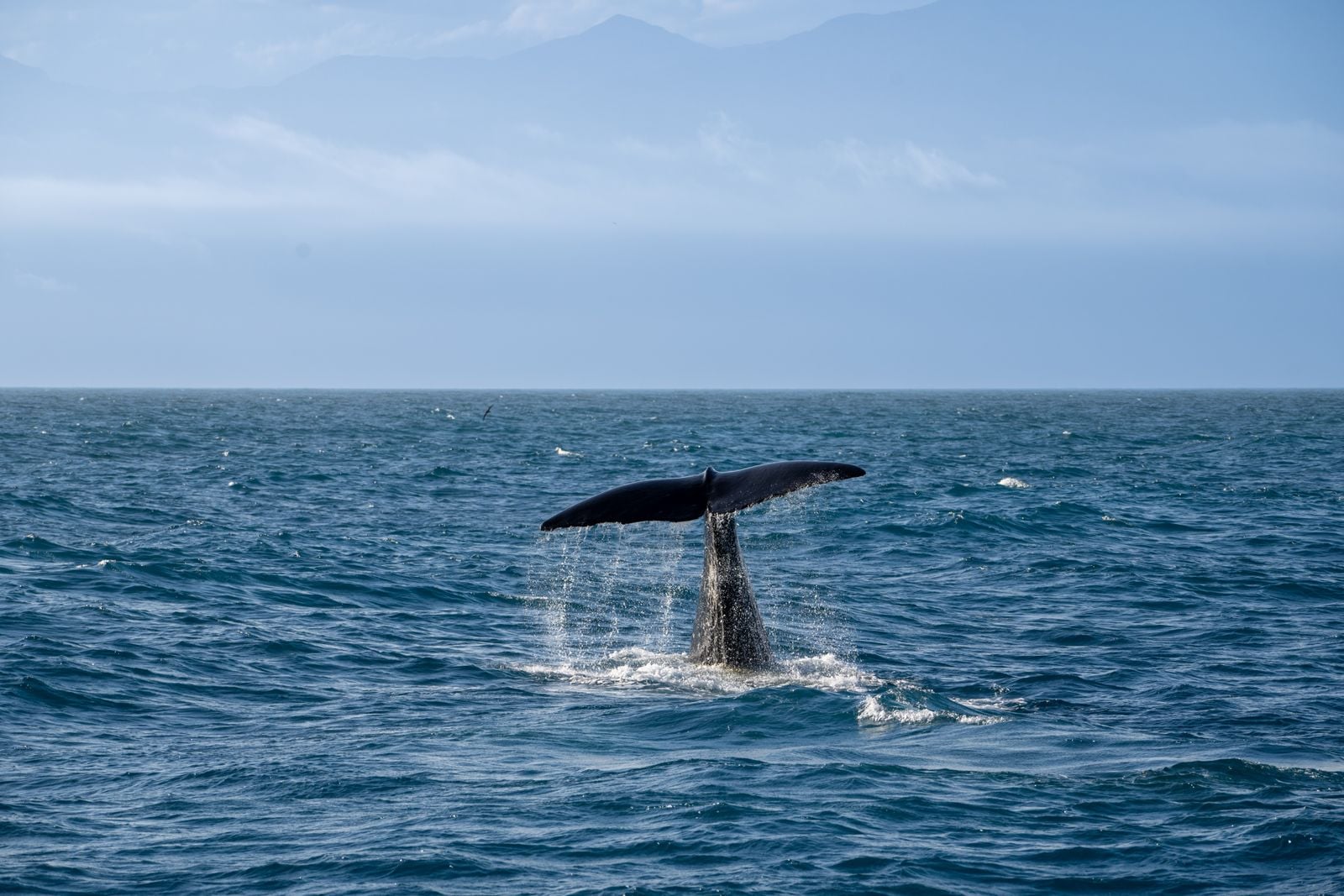
When a tagged whale stops moving and goes silent, these instruments reveal the whale’s body drifting upward at a steep angle, flukes hanging down, and echolocation clicks ceasing. Drone footage has since complemented these findings, capturing pods drifting in formation from above near the Azores and Balearic Islands. This non-invasive filming offers unprecedented insight into sperm whale behavior, far beyond what early observers could achieve.
The Smithsonian Institution notes that these advanced methods are revolutionizing our understanding of sperm whales, documenting complex behaviors like headbutting and now, their sleep patterns, without disturbing the animals.
The Shortest Sleep Cycle of Any Mammal
Mammalian sleep cycles traditionally alternate between slow-wave sleep and REM sleep, varying widely in length and duration across species. Sperm whales exhibit a highly compressed sleep cycle, with individual bouts lasting just twelve to fifteen minutes, totaling less than two hours of sleep per 24-hour period.
It remains unclear whether these short naps include REM sleep, as obtaining direct brain activity recordings from free-swimming sperm whales is nearly impossible. Researchers infer sleep stages from behavioral and postural data. Emerging comparative studies, including work on the lizard Pogona vitticeps, demonstrate that sleep architecture is far more diverse than previously thought, positioning the sperm whale’s brief sleep as an extreme point on a broad evolutionary continuum.
What the Silence Sounds Like
When awake, sperm whales are among the loudest animals on Earth. Their echolocation clicks can reach over 230 decibels at the source—louder than a rifle shot—and pods communicate with patterned bursts called codas. Individual whales also emit slow trains of foraging clicks audible kilometers away on hydrophones.
By contrast, a sleeping pod produces absolute silence. Acoustic tags record a complete absence of sound during drift-sleep periods—no clicks, no codas, no fluke movements. For fifteen minutes, these ocean giants transform from some of the loudest creatures into the quietest objects in their environment.
This stark contrast highlights the uniqueness of sperm whale sleep compared to other long-lived cetaceans like bowhead whales, which live over 200 years but whose sleep patterns remain largely uncharacterized due to the challenges of tracking them beneath Arctic sea ice.
Fifteen Minutes in the Open Ocean
As the pod drifts silently, calves nestled safely in the middle, the ocean fades from sunlit blue near the surface to near-black depths below. The whales hang vertically, motionless, and sensors record flat lines in depth, pitch, roll, and sound for fourteen minutes and forty seconds. Then, one whale exhales, releasing a misty spout into the air, and the pod stirs back to life.
The whales resume clicking, tilt forward, beat their flukes once, and descend into the deep to hunt squid once again.
But what truly transpires within those fifteen minutes of stillness? If both hemispheres of the whale’s brain indeed go quiet, is their state analogous to human unconsciousness, or something altogether different? Why has evolution favored such a compressed sleep schedule in this largest-toothed predator, and what are the long-term costs, if any, to memory, tissue repair, or attentiveness? While technology reveals when the whale is still, the mysteries of what it dreams—or if it dreams at all—remain elusive.
To explore this fascinating topic further, visit the original comprehensive article Here.

