
Helion Energy Secures $175 Million to Revolutionize Fusion Power Electronics
Fusion startup Helion announced on Thursday that it has been awarded $175 million in federal funding to accelerate the research, development, and manufacturing of advanced semiconductors and power electronics critical to its fusion power plants. This investment underscores the pivotal role semiconductor efficiency plays in Helion’s goal to deliver clean, reliable fusion energy to the grid.
Currently, the power electronics devices integral to Helion’s fusion systems experience energy losses ranging from 5% to 10%. Though these percentages may appear modest, such losses can compound significantly within the complex architecture of the fusion power plant. “If we can cut that loss in half, that’s actually twice the power output of the fusion system,” said David Kirtley, co-founder and CEO of Helion, in an interview with TechCrunch.
Helion is racing to complete its first fusion power plant, Orion, with a target operational date by 2028. This timeline aligns with a commitment to supply Microsoft with electricity directly from the fusion grid. The new federal funding will support the establishment of automated semiconductor module production, packaging, and testing capacity to meet the demands of the fusion machine currently under construction.
The planned production line, located in Washington State, will be the first in the United States dedicated to manufacturing a specialized class of semiconductors used not only in fusion power but also across industries such as manufacturing, wastewater treatment, medicine, and defense sectors. “There are no U.S. manufacturers right now that do it,” Kirtley emphasized. “This is absolutely enabling going from zero to 100 for advanced, high-voltage, and pulsed semiconductors here in the United States.”
Fresh Funding Bolsters Semiconductor Manufacturing Efforts
Image Credits: Mike Kane/Bloomberg (opens in a new window) / Getty Images
The $175 million award from the Department of Commerce falls under the CHIPS Act, a Biden-era initiative aimed at revitalizing semiconductor research, development, and manufacturing in the U.S. In addition to this federal support, Helion disclosed a fresh $50 million private investment, bringing its total funding to over $3.2 billion. This positions Helion as the second-best-funded fusion startup globally.
Approximately $100 million of the funding will be allocated toward semiconductor and advanced packaging research and development in Washington State. Another $80 million will support efforts in Vermont focused on advanced semiconductor tooling, design, and process development in collaboration with GlobalFoundries. Notably, GlobalFoundries has also secured over $80 million in federal funding to advance gallium-nitride semiconductor manufacturing, a technology widely used in power electronics.
As part of the funding agreement, the government will receive a $175 million non-voting equity stake in Helion based on its Series G valuation. While the R&D supported by this award will not feed directly into the Orion plant due to federal contract timelines, Kirtley noted that these advancements will enhance the efficiency and competitiveness of future Helion power plants in increasingly competitive electricity markets.
Efficiency is Everything in Helion’s Fusion Approach
Helion’s fusion technology is distinctive because it captures electricity directly from the fusion reactions rather than converting heat to steam to drive turbines, a method that can significantly improve overall efficiency.
The company’s reactor design employs a field-reversed configuration where fusion fuel—primarily deuterium and helium-3—is injected into an hourglass-shaped chamber from both ends. The fuel is heated into plasma and accelerated toward each other using magnetic fields. Upon collision, another magnetic field compresses the plasma further, raising temperatures above 100 million degrees Celsius.
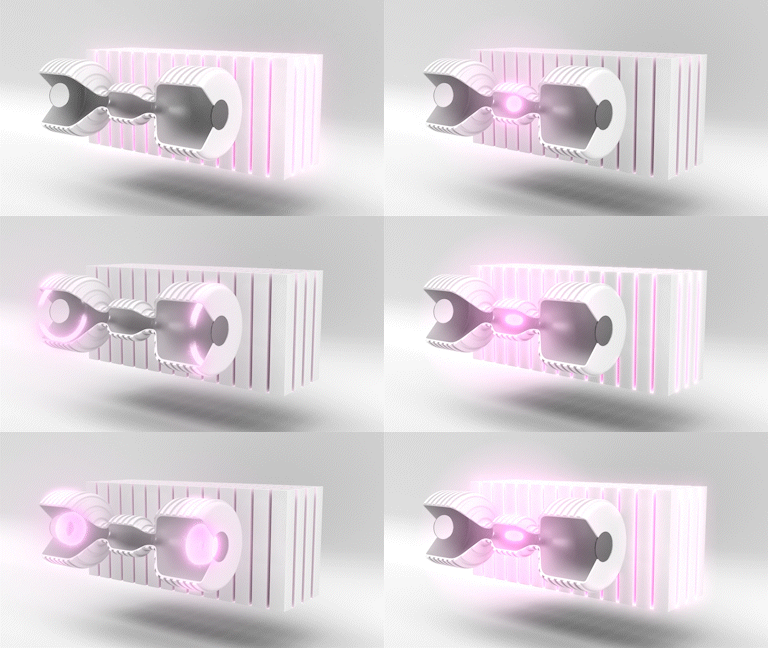
Image Credits: Helion
At these extreme conditions, the fusion fuel atoms fuse, releasing energy and pushing the plasma outward. This outward force pushes against the magnetic field, and the energy is captured by magnets and capacitors, converting it into electricity. This mechanism is akin to regenerative braking in hybrid or electric vehicles, where electric motors recapture kinetic energy to recharge batteries.
This process, known as direct energy conversion, is central to Helion’s vision of building reactors capable of generating more power than they consume—a critical milestone for commercial fusion energy viability. High-performance power electronics are crucial to achieving this goal.
“One of the enabling parts of our technology that allows us to do this direct electricity recovery—putting electricity into fusion and at a very high efficiency, recovering it at high speed—is the modern semiconductor,” Kirtley explained. “We’re going to take that to the next level here, increase the efficiency.”
Beyond fusion, advanced power electronics have the potential to profoundly impact other sectors. Electric vehicles represent the broadest current application, but industries such as consumer electronics and defense stand to benefit as well. For instance, energy weapons are gaining renewed attention due to the increasing use of drones in modern warfare, which challenges existing air defense mechanisms. Bill Frauenhofer, head of semiconductor investment and innovation at the Department of Commerce, highlighted that the award will aid in “converting and delivering power to critical applications in defense, grid transmission, and advanced energy generation.”
Despite opportunities in defense, Helion remains steadfast in its primary mission: “Domestic energy supply, national security through energy dominance, and energy security—that’s our main focus,” Kirtley affirmed.
Update 10/23 at 9 am ET: Adds details about government stake in Helion.
When you purchase through links in our articles, we may earn a small commission. This doesn’t affect our editorial independence.
Source: Here

