
The Longevity Paradox: Balancing Mental Health and Lifespan
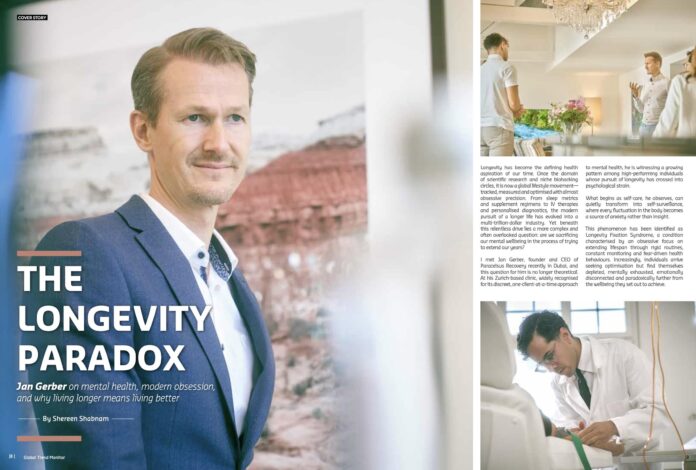
Jan Gerber on mental health, modern obsession, and why living longer means living better
By Shereen Shabnam
Longevity has become the defining health aspiration of our time. What was once a subject confined to scientific research and niche biohacking communities has expanded into a global lifestyle phenomenon. Today, millions meticulously track sleep patterns, supplement intakes, and even undergo intravenous therapies and personalised diagnostics—all in the pursuit of extending lifespan and enhancing overall vitality. This pursuit has birthed a multi-trillion-dollar industry, reflecting society’s growing obsession with living longer.
However, this relentless focus on longevity raises a crucial, often overlooked question: at what cost to our mental wellbeing? Jan Gerber, founder and CEO of Paracelsus Recovery, a Zurich-based clinic renowned for its discreet, one-client-at-a-time mental health treatments, offers a unique perspective. In his experience, the quest for prolonged life increasingly manifests as psychological strain among high-functioning individuals. What begins as conscientious self-care can morph into what Gerber terms “self-surveillance,” where constant monitoring of bodily functions triggers anxiety rather than reassurance.
Understanding Longevity Fixation Syndrome
This emerging condition, referred to as Longevity Fixation Syndrome, is characterised by an obsessive fixation on extending lifespan through rigid routines, continuous health tracking, and fear-driven behaviours. Rather than achieving greater wellbeing, many individuals find themselves mentally drained, emotionally detached, and paradoxically, further from their health goals. This phenomenon underscores a critical paradox: the very efforts to control and optimise health can inadvertently undermine it.
Gerber explains that the modern narrative around longevity often prioritises control—over diet, sleep, physical performance, and ageing itself. Yet, this hyper-control can elevate stress hormones such as cortisol, disrupt natural sleep cycles, and provoke chronic inflammation. These physiological responses, often mistaken for results of poor health habits, frequently stem from the stress of attempting to perfect them.
The Interplay Between Mental Health and Longevity
“There is no longevity without mental health,” Gerber asserts—an insight that shifts the conversation from external optimisation to internal balance. This viewpoint aligns with decades of scientific research. Longitudinal studies consistently identify social connection and emotional resilience as the strongest predictors of longevity, surpassing diet, exercise, or genetics. For example, a landmark meta-analysis published in PLoS Medicine (2010) found that individuals with strong social relationships have a 50% greater likelihood of survival over time compared to those with weaker ties.
Connection not only provides emotional support but also regulates physiological stress responses, enhancing immune function and reducing inflammation. This biological grounding contrasts sharply with today’s hyper-individualised wellness culture, which often neglects the social and emotional dimensions of health. Historically, human survival and wellbeing depended on community, shared purpose, and belonging—foundations that modern wellness trends sometimes overlook.
A Holistic Approach at Paracelsus Recovery
At Paracelsus Recovery, Gerber integrates psychiatry and psychotherapy with longevity-focused functional medicine, a practice predating its recent surge in popularity. Each treatment programme is meticulously personalised, addressing mental health alongside biological systems such as the gut microbiome, hormonal balance, micronutrient status, and inflammatory markers. This comprehensive approach reflects a broader healthcare paradigm shift—from isolated symptom treatment to whole-person care supported by advanced diagnostics including genetic profiling and extensive laboratory testing.
Despite these sophisticated methodologies, Gerber emphasises that no amount of medical intervention can substitute for the fundamental human need for connection. Many patients’ challenges are rooted not in lack of knowledge or access but in unresolved emotional issues, loneliness, chronic stress, and diminished purpose. These factors are especially prevalent among high achievers, whose professional success often comes at the expense of emotional wellbeing.
Managing Anxiety and Embracing Balance
Anxiety is a natural response to uncertainty, but in today’s world of constant stimulation, information overload, and relentless performance pressure, this response can become chronic and debilitating. Gerber highlights the importance of discerning between healthy vigilance—an adaptive awareness that supports proactive self-care—and spiralling control, which reduces life to data points, leaving little room for spontaneity, joy, or meaningful connection.
As the global wellness industry continues to expand rapidly, this distinction grows increasingly vital. Longevity, once a fringe concept, is now mainstream. But Gerber’s insights remind us that its true value lies not in the sheer number of years lived, but in the quality and richness of those years. Mental health and human connection are not optional add-ons but essential pillars of a truly long and fulfilling life.
For those seeking to optimise longevity, the key takeaway is clear: prioritise emotional resilience and social ties alongside physical health. By embracing this holistic view, we can navigate the longevity paradox and achieve not just a longer life, but a better one.
Source: Here
